How Professional Services Firms Stop Losing Enquiries: The Enquiry-to-Client Journey
Most professional services firms don't have a visibility problem, they have a conversion problem. Here's where enquiries leak and how to close the gap.
On this page
Your marketing may be generating the enquiries your firm needs. The problem may be what happens after those enquiries arrive.
A prospective client finds your firm through Google, paid advertising, a referral or another marketing channel. They visit your website, review your services and decide to make contact.
At that point, the marketing has done its job.
But if the call is missed, the enquiry sits unanswered for several hours, or the first response is followed by no meaningful follow-up, the opportunity can disappear before the firm has had a genuine conversation with the prospect.
This is a common conversion problem across professional services.
Law firms, accountancy practices, immigration consultancies and advisory firms can invest substantially in generating demand while paying far less attention to the systems responsible for converting that demand into consultations and clients.
The result is a familiar pattern: more traffic, more enquiries and disappointing growth.
The answer is not always another marketing channel.
Sometimes, the bigger opportunity is to improve what happens between the first enquiry and the signed client.
This guide examines where professional services firms typically lose enquiries, why response time matters, how structured follow-up improves the client journey, and how automation can strengthen the process without removing the human expertise that professional services depend on.
Key Takeaways
- Marketing performance cannot be measured only by enquiries generated. The commercial outcome depends on what happens after an enquiry is received.
- Missed calls represent lost opportunities. Clio's 2024 UK Legal Trends research found that only 40% of law firms in its mystery-shopping study answered calls, while 48% were effectively unreachable by phone because they neither answered nor returned the call. (Clio)
- Response time has a measurable effect on lead qualification. Harvard Business Review research found that companies contacting online leads within an hour were nearly seven times as likely to qualify them as companies that waited longer. (Harvard Business Review)
- A first response is not the same as a follow-up strategy. Prospects can become inactive for many reasons that have nothing to do with a lack of interest, making structured follow-up an important part of the conversion process.
- Existing contacts can represent an overlooked source of pipeline. Database re-engagement allows firms to develop opportunities among people who have already interacted with the business.
- Automation should support the client journey rather than replace professional judgement. The most valuable applications are usually response, routing, scheduling, follow-up and other repetitive processes.
Why Professional Services Marketing Often Breaks at Conversion
Professional services firms naturally focus on visibility.
They invest in search engine optimisation, paid search, content, referrals, social media and websites because these activities create opportunities to engage prospective clients.
However, generating an inquiry is only one stage of the acquisition process.
Once someone makes contact, the firm has to respond, establish what the prospect needs, create confidence, arrange the appropriate next step and maintain the relationship until a decision is made.
That creates a second layer of marketing performance that is often overlooked.
A firm may know exactly how many visitors reached its website last month, how many enquiries were generated and how much was spent on advertising. It may not know how quickly those enquiries were answered, how many received a second follow-up or where prospects stopped progressing.
This distinction matters because a lead has value only when the business has an effective process for converting the opportunity.
Increasing lead volume cannot compensate indefinitely for weaknesses further down the funnel.
In fact, if a firm generates more enquiries without improving its response and follow-up processes, it can simply increase the number of opportunities being lost.
Where Professional Services Firms Lose Enquiries
There are three recurring points of leakage in the enquiry-to-client journey:
- The initial contact is missed or delayed.
- The first response does not happen quickly enough.
- Follow-up stops before the prospect has made a decision.
Each represents a different problem, but they are connected.
A prospect who cannot reach the firm may never become an active lead. A prospect who receives a delayed response may move to another provider. A prospect who remains interested but receives no follow-up may simply disappear from the pipeline.
1. Missed Calls Create an Immediate Conversion Gap
Phone enquiries are particularly important because calling requires a higher level of intent than simply browsing a website.
The prospect has decided that they want to speak to the firm.
They may be dealing with a legal issue, preparing an immigration application, looking for professional accounting support or evaluating an advisory service. Whatever the reason, the decision to call represents a meaningful step in the buying journey.
When that call goes unanswered, the firm has created friction at precisely the point when the prospect is ready to engage.
Clio's2024 Legal Trends research illustrates the scale of the issue within the legal sector. In its mystery-shopping study of 500 law firms, only 40% answered calls. When returned calls were included, 52% either answered or returned the call, meaning 48% were effectively unreachable by phone. (Clio)
Although this research focuses on law firms, the underlying commercial issue applies more broadly: when a prospective client cannot reach a firm, the opportunity does not remain available indefinitely.
The solution is not necessarily more staff
A missed call should trigger a defined response.
An immediate text acknowledgement can confirm that the firm received the call and provide the prospect with another way to continue the conversation. The team can then respond when available without allowing the enquiry to disappear completely.
The objective is simple: turn a missed interaction into an active opportunity rather than allowing it to become a lost lead.
2. Slow Response Times Reduce the Opportunity to Convert
The same principle applies to website enquiries.
A prospect submits a form because they are interested enough to make contact. If the firm takes several hours, or even a day, to respond, the prospect has had considerable time to continue their search.
Harvard Business Review's research into online sales leads found that the average response time among companies that responded was 42 hours. Only 37% responded within an hour, while 23% never responded. The research also found that companies contacting leads within an hour were nearly seven times as likely to qualify them as companies that waited longer. (Harvard Business Review)
The important lesson is not that every professional services enquiry requires an immediate consultation.
It is that the firm should respond quickly enough to preserve the opportunity for a meaningful conversation.
The first response has a specific purpose
The initial acknowledgement does not need to resolve the prospect's entire situation.
It should establish three things:
The enquiry has been received.
The prospect should know that their message reached the right firm.
The next step is clear.
The prospect should understand what will happen and when.
The conversation can continue.
Where appropriate, the prospect should have an option to book a consultation, provide additional information or respond directly.
For example:
“Thank you for getting in touch regarding your business visitor visa enquiry. We have received your details and a member of our team will review them. If you would prefer to discuss your situation directly, you can book a consultation here.”
This provides substantially more reassurance than a generic acknowledgement.
3. Weak Follow-Up Allows Interested Prospects to Disappear
The third problem is less visible but equally important.
A firm responds to an enquiry.
The prospect does not reply.
The enquiry is then considered inactive.
That conclusion may be premature.
Prospects can stop responding because they are busy, comparing providers, gathering information, discussing the decision internally or simply not ready to proceed at that particular moment.
Silence does not necessarily mean rejection.
This is why a single acknowledgement email should not be considered a complete follow-up process.
Build follow-up around useful next steps
A structured sequence might include:
Initial response: Confirm receipt and establish the next step.
Follow-up: Provide additional information relevant to the enquiry.
Second follow-up: Address a common question or concern.
Further contact: Provide a clear route to consultation or another appropriate action.
Longer-term nurture: Where appropriate, continue communicating with suitable prospects rather than allowing them to disappear permanently.
The exact timing should depend on the firm's service, sales cycle and prospect intent.
The objective is not to repeatedly ask whether someone is still interested.
It is to provide useful reasons for the prospect to continue the conversation.
Your Existing Database May Contain Untapped Opportunities
Generating new leads is only one way to create a pipeline.
Most established firms already have a database containing previous enquiries, consultations, former clients and prospects who started a conversation but never progressed.
In many cases, those contacts receive little or no marketing after the initial interaction.
That represents an opportunity.
A previous prospect already has some familiarity with the firm. The business does not need to establish its existence from the beginning.
Instead, it needs to identify an appropriate reason to reconnect.
For example:
- An immigration consultancy could reconnect with previous prospects when a relevant service or process changes.
- An accounting firm could provide useful information ahead of an important tax deadline.
- A law firm could share an update relevant to a specific area of previous enquiry.
- An advisory firm could reconnect with businesses that previously considered a service but did not proceed.
The approach should be relevant and appropriately permissioned rather than simply sending promotional messages to an old list.
The underlying principle is straightforward:
Before spending more money acquiring attention, examine the opportunities you have already paid to acquire.
Where AI and Automation Fit Into the Enquiry Journey
AI is useful when it solves a defined operational problem.
For professional services firms, responsiveness is one of those problems.
Enquiries can arrive outside office hours. Staff can be occupied with existing clients. Several enquiries can arrive simultaneously. Follow-up can be delayed because it depends on manual reminders.
Automation can provide consistency across those situations.
The objective is not to automate the professional relationship.
It is to automate the repetitive parts that surround it.
AI Voice and Chat
AI voice and chat can help firms respond to enquiries, collect preliminary information, answer approved questions, qualify prospects and assist with appointment scheduling.
The boundaries are important.
A professional services firm's AI system should operate using approved information and defined escalation rules. Matters requiring professional judgement should be transferred to an appropriately qualified person.
This creates a useful division of responsibility:
Automation handles speed and consistency.
Professionals handle judgement and expertise.
Research in the legal sector suggests that technology is becoming increasingly integrated into client acquisition and service delivery. Clio's 2024 Legal Trends research reported that 79% of legal professionals surveyed were using AI in some capacity. (Clio)
The figure is specific to the surveyed legal professionals and should not be assumed to represent every professional services sector, but it illustrates how quickly these tools are becoming part of the industry's technology landscape.
Missed-Call Texting Creates a Second Route Into the Conversation
The same principle can be applied to telephone enquiries.
When a call is missed, an automated message can acknowledge the call and provide a route for the prospect to continue the conversation.
This does not replace the eventual human interaction.
It protects the opportunity until that interaction can take place.
For firms receiving enquiries outside normal working hours, the distinction can be particularly important.
The office may be closed.
The enquiry does not have to be.
Remarketing Helps Maintain Visibility During the Decision Process
Not every prospect is ready to become a client immediately.
Professional services purchases can involve research, comparison, internal discussion and financial consideration.
Remarketing can help maintain visibility during this period, particularly when the prospect has already demonstrated interest in a specific service.
The key is relevance.
Someone who visited an immigration service page should receive messaging relevant to that decision rather than a generic advertisement for the entire firm.
Remarketing should support the decision-making process rather than simply increase advertising frequency.
The Five Metrics Professional Services Firms Should Track
A firm does not need dozens of marketing metrics to understand whether its enquiry process is working.
Start with five.
1. Enquiries Received
How many genuine enquiries are being generated?
This establishes the volume entering the funnel.
2. First Response Time
How quickly does the firm acknowledge and respond to the enquiry?
Track actual performance rather than relying on an assumed service standard.
3. Enquiry-to-Consultation Conversion
What percentage of enquiries progress to a consultation or meaningful sales conversation?
4. Consultation-to-Client Conversion
What percentage of consultations become paying clients?
5. Client Acquisition Cost
How much does it cost to acquire a client from each major marketing channel?
These figures create a much clearer picture of marketing performance.
For example:
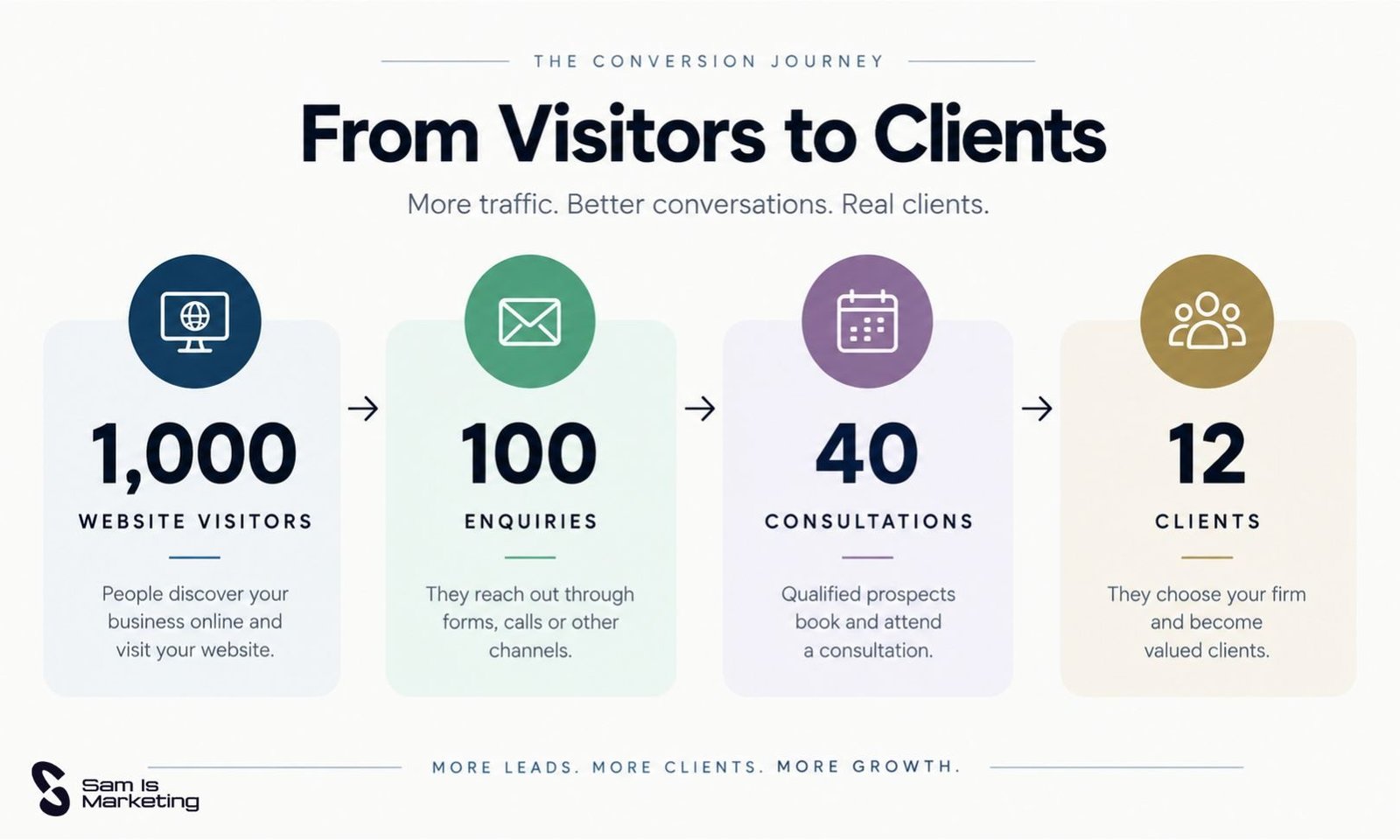
If the firm improves its enquiry process and increases the number of consultations without increasing traffic, it has created additional commercial value from the marketing investment it is already making.
That is the difference between generating more demand and converting more of the demand you already have.
Build the Enquiry-to-Client Journey Around the Prospect
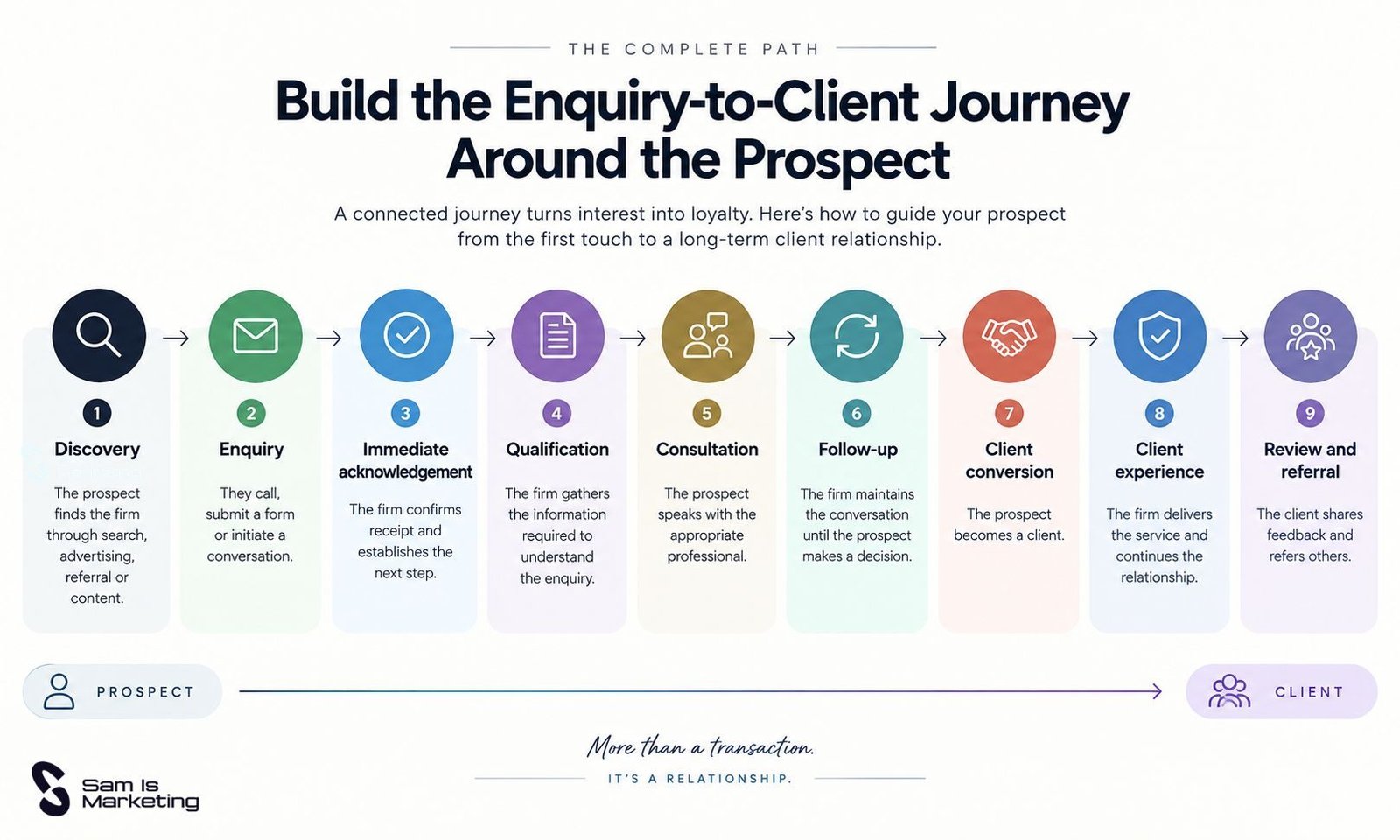
Satisfied clients are given an appropriate opportunity to provide feedback or refer others.
The important point is that each stage should have an owner, a process and a measurable outcome.
Without those three things, the journey is likely to depend on individual staff members remembering what needs to happen next.
What Should Professional Services Firms Automate?
Automation works best where the process is repetitive, predictable and time-sensitive.
Potential applications include:
- enquiry acknowledgements
- missed-call texts
- appointment confirmations
- consultation reminders
- follow-up sequences
- basic enquiry qualification
- appointment scheduling
- database re-engagement
- review requests
- frequently asked questions
The areas requiring professional judgement, empathy and expertise should remain human-led.
The goal is not to remove people from the client journey.
It is to ensure that people spend their time where their expertise creates the greatest value.
How to Find the Leaks in Your Own Funnel
You do not need a complicated audit to begin.
Take a sample of your recent enquiries and trace what happened to each one.
Record:
- When the enquiry arrived
- How it arrived
- How quickly the firm responded
- Whether the prospect received follow-up
- Whether a consultation was booked
- Whether the consultation occurred
- Whether the prospect became a client
- Which marketing channel generated the original enquiry
You will quickly begin to see where opportunities are disappearing.
Perhaps the firm's SEO is generating good enquiries but response times are slow.
Perhaps paid advertising is generating consultations but follow-up after the consultation is inconsistent.
Perhaps the website produces plenty of enquiries but the form creates unnecessary friction.
The value of measuring the journey is that it turns a vague marketing problem into a specific operational problem.
And specific problems are much easier to fix.
Should You Build the System In-House?
Some firms can.
A larger organisation with internal marketing, operations and technical resources may have the capability to connect its website, forms, telephone system, messaging, calendars, follow-up and reporting internally.
The challenge is maintaining the system.
Every disconnected platform creates another integration to manage and another process that can depend on manual intervention.
A website may generate the enquiry.
A phone platform may handle the call.
An inbox may receive the notification.
A separate calendar may handle appointments.
A spreadsheet may track follow-up.
An advertising platform may contain the source data.
At that point, the firm technically has several tools, but not necessarily a connected enquiry system.
For smaller and mid-sized professional services firms, a managed solution can reduce that operational complexity.
The important question is not whether a firm should use more technology.
It is:
Where is the enquiry journey currently breaking, and what is the simplest reliable way to fix it?
Frequently Asked Questions
Why do professional services firms lose enquiries after investing in marketing?
Because lead generation and lead conversion are separate stages of the customer journey.
A firm can generate substantial traffic and enquiries while losing opportunities through missed calls, slow responses, weak follow-up or unnecessary friction in the booking process.
How quickly should a professional services firm respond to a new enquiry?
As quickly as reasonably possible.
Harvard Business Review's research found that companies contacting online leads within an hour were nearly seven times as likely to qualify them as companies that waited longer. (Harvard Business Review)
An immediate acknowledgement combined with timely human follow-up is a practical structure for many firms.
Should professional services firms use AI chat?
AI can be useful for initial response, information collection, qualification, routing and scheduling.
It should operate within clearly defined boundaries and should not replace professional judgement where the matter requires qualified advice.
What is database re-engagement?
Database re-engagement involves communicating with suitable existing contacts who have previously interacted with the firm.
Rather than relying entirely on new lead acquisition, firms can identify appropriate opportunities within their existing database and create relevant reasons for those contacts to re-engage.
What marketing metrics should a professional services firm track?
At minimum, track enquiry volume, first response time, enquiry-to-consultation conversion, consultation-to-client conversion and client acquisition cost.
These metrics provide a more complete view of the commercial performance of marketing than traffic or lead volume alone.
The Goal Isn't More Enquiries. It's More Valuable Enquiries Becoming Clients.
Professional services firms will always need visibility.
They need to be found when prospective clients search for their services. They need strong websites, useful content, effective advertising and referral networks.
But visibility is only the beginning.
Once a prospect decides to make contact, the firm's own process takes over.
A missed call, delayed response or incomplete follow-up can undermine the investment that generated the enquiry in the first place.
The strongest enquiry journeys therefore connect marketing and conversion rather than treating them as separate activities.
Marketing creates the opportunity.
Responsiveness protects it.
Follow-up develops it.
The consultation converts it.
If your firm is already investing in SEO, paid advertising, referrals or content and the commercial results are not matching the level of investment, look beyond traffic.
Examine what happens after the prospect raises their hand.
How quickly are they contacted?
How many receive meaningful follow-up?
How many reach consultation?
How many become clients?
And how many disappear before anyone has a chance to understand why?
Those answers will tell you far more about your marketing performance than traffic numbers alone.
How Sam Is Marketing Helps Professional Services Firms Close the Gap
Sam Is Marketing works with law firms, accountancy practices, immigration consultancies and advisory firms to identify where enquiries are being lost and build systems that improve the journey from first contact to consultation and client.
This can include AI voice and chat, missed-call texting, automated follow-up, database re-engagement, consultation booking and connected enquiry management.
Sources